Flag State Endorsements: How the Process Works and Why It Delays Crew Changes
Endorsements are the least glamorous part of crewing and the most common cause of a missed joining date. Here is what actually happens between application and approval.
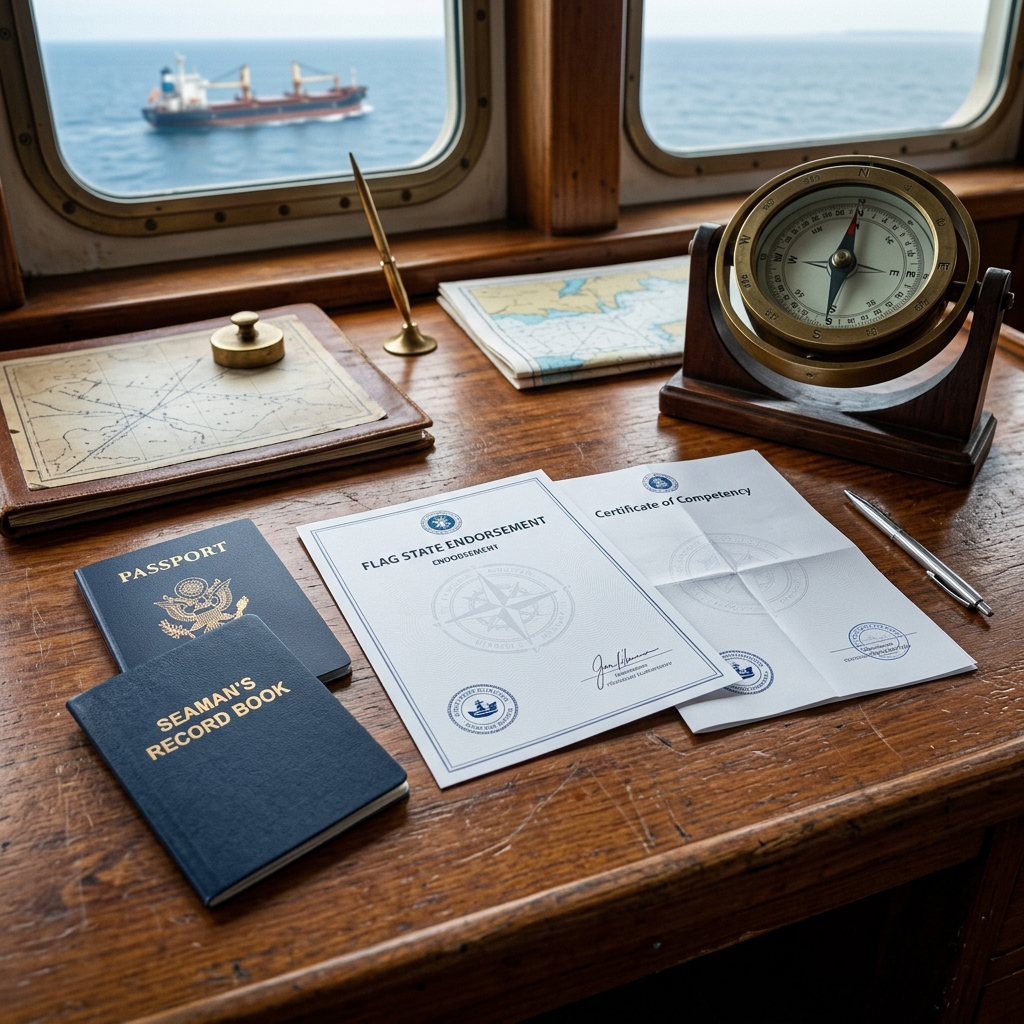
A Certificate of Competency issued by India does not, by itself, permit an officer to serve on a Panamanian-flagged vessel. The flag state has to recognise that certificate and issue its own endorsement — a separate document, with its own application, its own fee and its own expiry date.
This requirement comes from STCW Regulation I/2, and it exists for a sound reason: a flag state carries responsibility for the competence of everyone serving on its vessels, so it satisfies itself about the training system that produced them. That is entirely reasonable. It is also the single most common reason a planned crew change does not happen on the planned date.
What actually happens after you apply
- Documents are assembled — COC, STCW modules, passport, CDC, medical certificate, photographs, application form and fee.
- The application is submitted, usually through the flag's online portal or an authorised regional office.
- The administration verifies the underlying COC directly with the issuing country. This step is outside anyone's control and is where most of the time goes.
- STCW modules and medical validity are checked against the flag's own requirements, which sometimes exceed the general convention standard.
- The endorsement is issued, typically valid until the underlying COC expires — never beyond it.
Realistic timelines
| Flag state | Typical processing | Notes |
|---|---|---|
| Panama | 7–15 working days | Large volume; regional offices vary in speed |
| Liberia | 5–10 working days | Well-developed online system |
| Marshall Islands | 5–12 working days | Strict on document completeness |
| Malta | 10–20 working days | EU requirements add checks |
| Singapore | 10–15 working days | High documentation standard |
| India | 15–30 working days | Varies with DG Shipping workload |
These are indicative. Every administration has busy periods, and a rejection resets the clock entirely rather than pausing it. Plan against the upper end of the range, not the lower.
Why applications get rejected
Rejections are rarely exotic. In practice they cluster around the same handful of causes:
- An STCW module has expired, or will expire before the endorsement would be issued.
- The medical certificate is from a clinic the flag does not recognise.
- Name spelling differs between passport, COC and CDC — a single transposed letter is enough.
- The training institute is not on the flag's approved list.
- Sea service documentation does not support the rank claimed.
- Photographs do not meet the specification, which sounds trivial and is not.
- The underlying COC is within months of expiry, so the flag declines to endorse it.
Almost every item on that list is detectable before submission by someone reading the application against the flag's published requirements. That is the entire value of a documentation desk: not speed, but not having to do it twice.
The dependency chain people forget
An endorsement cannot outlive the certificate it endorses. Renew a COC without renewing the endorsement and you hold a valid licence with no permission to use it on that flag. Equally, an endorsement issued against a COC expiring in four months will itself expire in four months, regardless of the standard validity period.
The practical rule is to sequence renewals: COC first, then endorsement, then check both against the intended contract length before booking travel.
Planning around it
Owners who rarely miss crew change dates tend to do four things. They start the endorsement process at nomination rather than at contract signature. They maintain a certificate register with alerts at ninety days. They check completeness against the flag's published checklist before filing. And they build the upper end of the processing range into the crew change plan rather than the lower.
The joining date is not set by when you found the candidate. It is set by the slowest government office in the chain.
When the timeline will not work
Sometimes the endorsement simply cannot be issued in time. At that point there are three honest options: expedite where the flag offers a paid fast-track, substitute a candidate who already holds a valid endorsement for that flag, or move the crew change to the next suitable port. The dishonest fourth option — sending the seafarer and hoping — ends with someone stranded at an immigration counter and a vessel still short-handed.